Tuesday, August 24, 2010

The Daily Commute

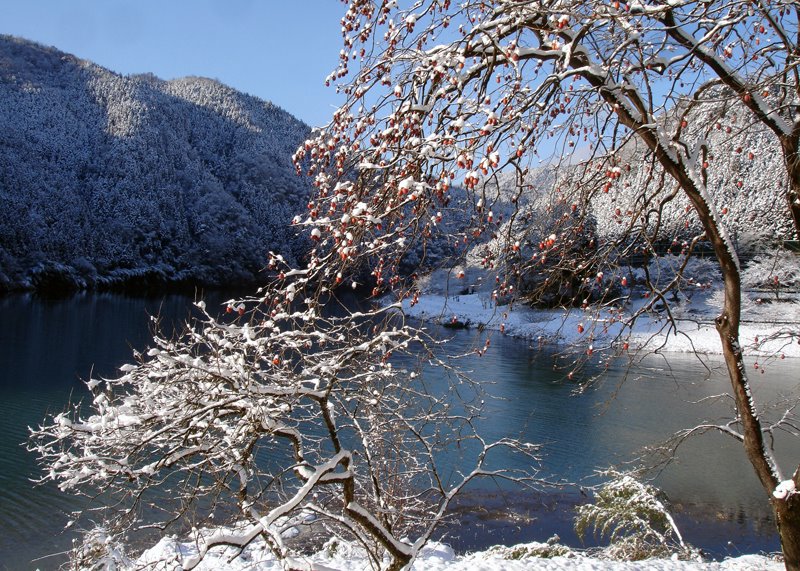
Snow-covered persimmons, dangling over the shivering surface of the Kiso River like tangerine tear drops of sunshine. This is the view from my beautiful mountain school, North Ena Junior High. (Click on the photo to see a larger version).

Image hosted by Photobucket.com

Nothing says "Saftey Driving" (as our Japanese friends say) as operating a motor vehicle on a slippery, winding road through the mountains with one hand out the window taking pictures! The ride to work, this morning was just too breath-taking. The pine covered slopes, frosted with a fresh cover of over-night snow, seemed to rise higher on every side as I headed towards my beautiful mountain school. The blue sky, the warm sun, and the way the sugar powdered mountains melded with the fluffy, frosty, clouds hanging low with heavy snow was like a dream...a winter fantasy. Before the snow started falling, I could have sworn I would be happy to skip winter all together, but i will never be able to forget the way the mountains look blanketed in snow, or seeing Ontake's pristine peak rise over the southern alps that embrace my town. Yay for winter!

Karyukai: The Flower and Willow World

Memoirs of a Geisha opens today in Japan! Finally I will get to see a movie before everyone back home!


Image hosted by Photobucket.com

Image hosted by Photobucket.com

Image hosted by Photobucket.com

Fall In Gion: Gion Odori

Image hosted by Photobucket.com
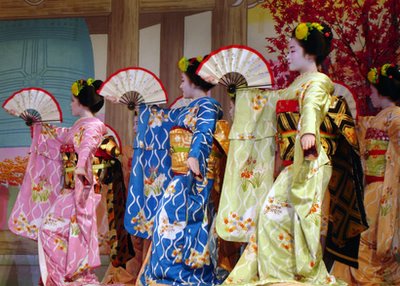
Tsunesono, a geiko of Gion, strikes a feminie pose characteristic of Kyomai, Kyoto's traditional style of dance.

Image hosted by Photobucket.com
Two geiko Gion of dancing kyomai. The shadow of the geiko Tsuneyu was just too perfect! She was like a porcelain doll.

Image hosted by Photobucket.com
Tsuneyu, an older geiko, moved so gracefully I couldnt take my eyes off her. Since Tsuneyu and Tusnesono both share the "Tsu" in their names, they must come from the same Okiya, or geisha house. In the flower and willow world, they are sisters.

Image hosted by Photobucket.com
Tsuneyu flutters her fan during the finale, the Song of Higashi Gion. This shot shows the difference in skill between a geiko and a maiko. Note the position of the hands, the fans, and the way their long sleeves are being held. Take a closer look on Flickr: Tsuneyu つねゆ.

Image hosted by Photobucket.com
Tsunesono also graced the stage for the final dance, along with all the participating geiko and maiko.
The vivd colors, luxurious silks and elegant design of the maiko's kimonos were breath-taking. These dances transport the audience to a world of ethereal beauty, where every movement is a perfect work of art.
The Book Club's Grand Tour of Kyoto

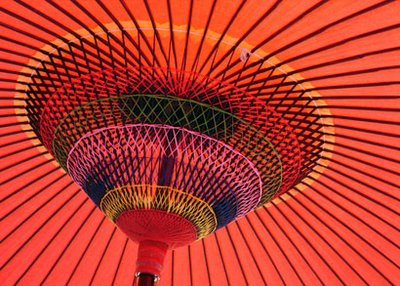
Paper umbrellas popped on the Japanese scene during the Edo period. Featured in many of the woodblock prints of Hiroshige Ando`s '100 scence of everyday life' these wax coated paper umbrella spared the people from the heat of the harsh, summer sun and sheltered them from rain. Utamaro Kitagawa also depicted these traditional umbrellas in his Ukiyoe (woodblock) masterpieces of beautiful women. These days, Japanese umbrellas play an important role in tea ceremony, dance, and Kabuki as an essential representation of Japanese traditional culture.
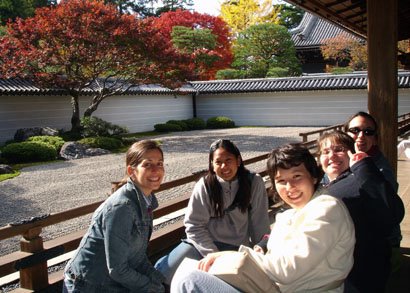
The 'book club' kids pause for a moment of meditation at one of Nanzenji`s rock gardens.

Image hosted by Photobucket.com
The thick wooden clogs of a maiko, or apprentice geisha. In the crowded Hanamikoji street, we heard the sound of many maiko girls' rushing to make their appointments. 'Kobo-kobo-kobo'is the onomonopia used to describe the sound of these shoes on the stone streets. 'Okobo', as they are called, have extremely thick soles, measuring 11cm.

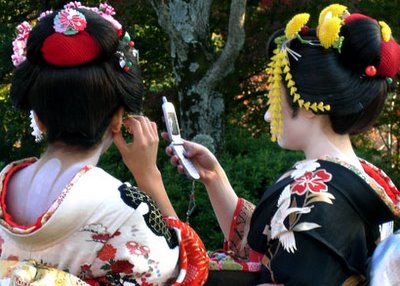
Two nisemono maiko, or imposters (toursits playing dress-up), send pictures of their transformation to friends via keatai, or mobile phone.

Image hosted by Photobucket.com
A very young maiko steps out with her 'big sister', one of the 17 maiko and geisha we saw walking the streets of Gion.

Image hosted by Photobucket.com
Another maiko hurrying down the Hanamikoji. Red and green are the 'in' colors this season. Seems even maiko are getting into the holiday spirit.


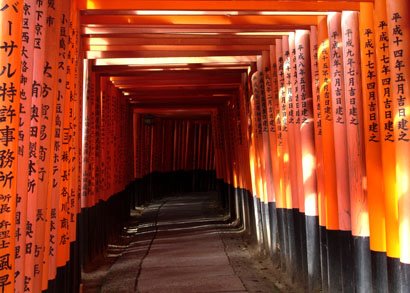
The tangerine tunnel of torii leading through the green trees and autumn leaves of Fushimi Inari.

Image hosted by Photobucket.com
The changing leaves above Fushimi Inari`s tunnel of torii.

Image hosted by Photobucket.com
Our trip was coming to an end, but our happy times were just beginning!

Tenryuji's Fall Foilage

Image hosted by Photobucket.com
The leaves at Sagano's Tenryuji (Heavenly Dragon Temple) are early this year, setting the temple gardens on fire in brillant hues of crimson.(Picture taken Nov.1st!)

Fall in Kyoto 

Image hosted by Photobucket.com
The changing leaves of Ohara's famous temple, Sanzenin.(Kyoto).

Japanese Culture and the Colors of Autumn

Image hosted by Photobucket.com
The fall colors of Sanzen-In, Kyoto. When the sun rays hit the red leaves and make them glitter warmly, it is called teriha (照葉 [てりは]).

As autumn deepens, the green leaves of deciduous trees begin to set the countryside on fire in shades of red, orange and yellow. This blaze of glory before winter sets in is admired around the world, but only in Japan has "Autumn Leaf Viewing" been ingrained as a popular cultural passtime.

The bright autumnal tints of Kyoto's foliage captivated the hearts of ancient Japanese people, who used them as motifs in literature and art for centuries. Autumn leaf viewing is thought to have become an organized event sometime during the Heian period, when the nobility would gather to listen to music, compose poems, or quietly delight in natures offering. Enjoying the fall colors is as important a traditional past time as viewing the cherry blossoms in the spring, but unlike cherry blossom viewing, which tends to be a rowdy affair, autumn viewing is a time of solitude and reflection.

Jidai Matsuri

An apprentice geisha, or maiko, dressed in Heian period costume at Jidai Matsuri.

The Jidai Matsuri, or Festival of Ages, is one of Kyoto's most famous festivals, along with Aoi Matsuri and Gion Matsuri. Held on October 22, it commemorates Emperor Kammu's decision to move the capital of his Empire from Nara to Kyoto on the same day in the year 794.

Image hosted by Photobucket.com
Chinese influence.

Originally instituted to raise Kyoto's moral after the loss of the capital and Imperial Court to Tokyo in 1868, it begins with the mikoshi (portable shrines) of the first and last Kyoto emperors being carried to the Old Imperial Palace, followed by a 5 hour long procession of approximately 2000 Kyoto natives dressed in lavish, period costumes representing styles from throughout Kyoto's history, beginning with the modernized soldiers of the Meiji era, corresponding with the end of the Kyoto capital in 1868, all the way back to the founding of the capital, during the Heian period.

Image hosted by Photobucket.com
A geisha laughs as she plays with a young girl.

Image hosted by Photobucket.com
A young girl dressed as a child of the Heian court.

Image hosted by Photobucket.com
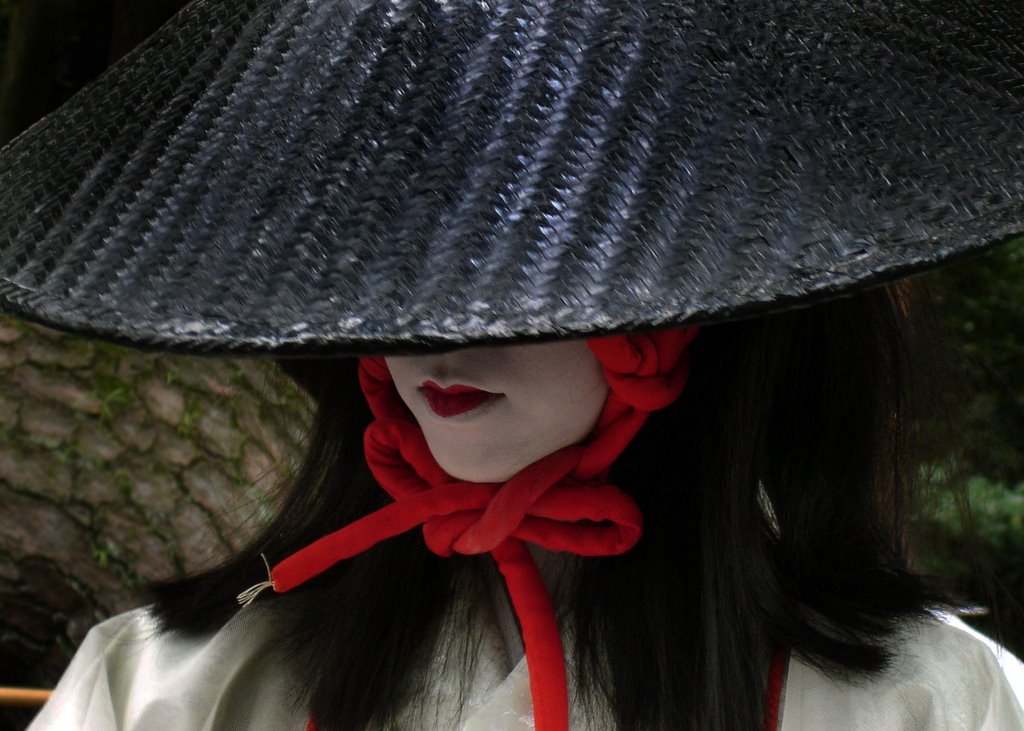
An apprentice Geisha, or maiko, seeking refuge beneath the veil of her Heian period costume.

Image hosted by Photobucket.com
A maiko and geiko chat while an older geisha in the background watches a young maiko take a quit shot with her ketai, or mobile phone.

Image hosted by Photobucket.com
Tomoe-Gozen was the wife of General Kiso Yoshinaka. She fought courageously alongside her husband in battle, one of the few examples of a true female samurai in japanese history.

Image hosted by Photobucket.com

Image hosted by Photobucket.com
MORE COMING SOON!

Ta Prom: The Jungle Temple

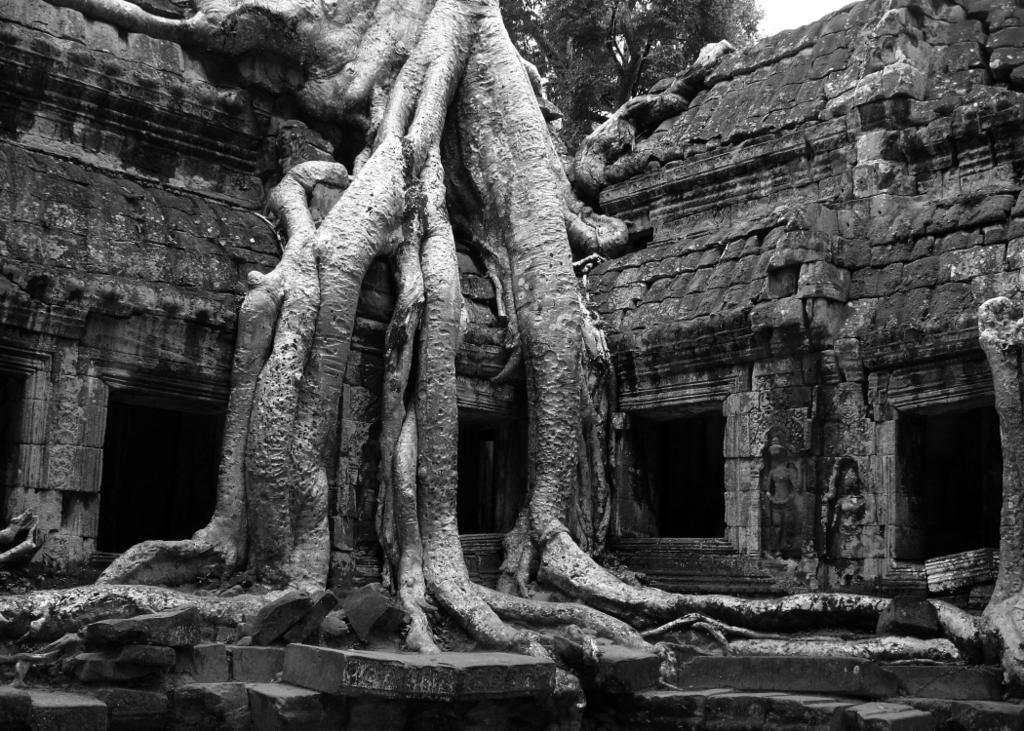
The temple of Ta Prom has been left more or less as it was found, with an overgrowth of jungle and portions tumbled down. It gives you some idea of what the first westerners found when they began exploring the area in the late 19th century.

When I told people I was going to Cambodia, they often asked "Cambodia? Why? What's there?" Once I said Angkor Wat, a light went off in many of their heads. "Oh! That's where they made Tomb Raider! Sweet!" Well, I haven't seen Tomb Raider (Angelina Jolie), and I probably never will. If you have, this may look a bit familliar.

Image hosted by Photobucket.com

Massive webs of Banyon roots cling to sandstone walls, stained by centuries and dancing with intricately carved apsaras. Mounds of moss-rocks, victims of neglect and the the crushing roots of the encroaching jungle, lie defeated, scattered throughout the temple grounds. Droplets of light trickling through the lush green foilage, caught in the mist of monsoon season, creates a mysterious, ethereal air.

Though many signs warn tourists of the danger of exploring most of the tumbling temple grounds, I couldnt help but scatter up mountains of fallen stones into hidden courtyards,stumbling over the tangle of knarled roots slithering down the walls and through the temple passages, and past the warning signs standing gaurd in the darkened doorways of the temple's shadow-veiled interior. I even stumbled into a small chamber acoustically designed so that when I beat upon my chest, the entire temple seemed to shutter from the thunderous echo. I was in full Indaina Jones mode. I could have stayed there forever.

Image hosted by Photobucket.com
Apparently this is the doorway where Angelina Jolie bends down and picks something up. Anyone who's seen the movie, please feel free to elaborate!

Image hosted by Photobucket.com

I was lucky to visit the temple at a time when most tourists are headed elsewhere! These few stand in awe.

The Road To Angkor Thom


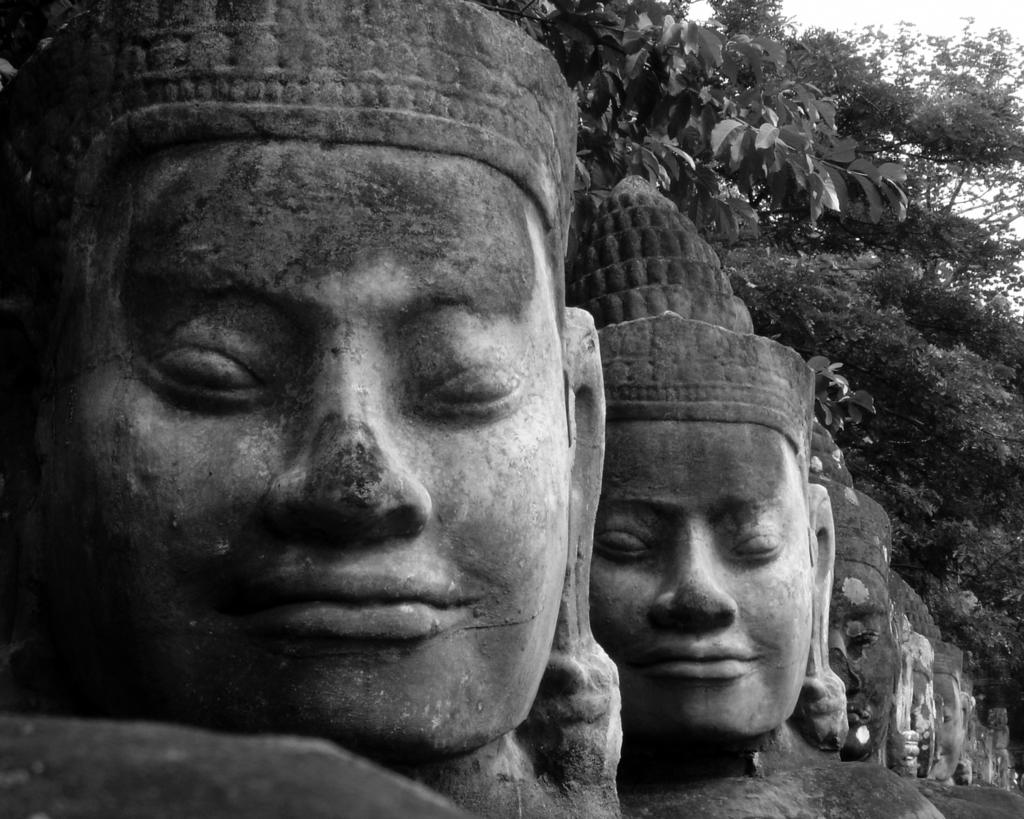
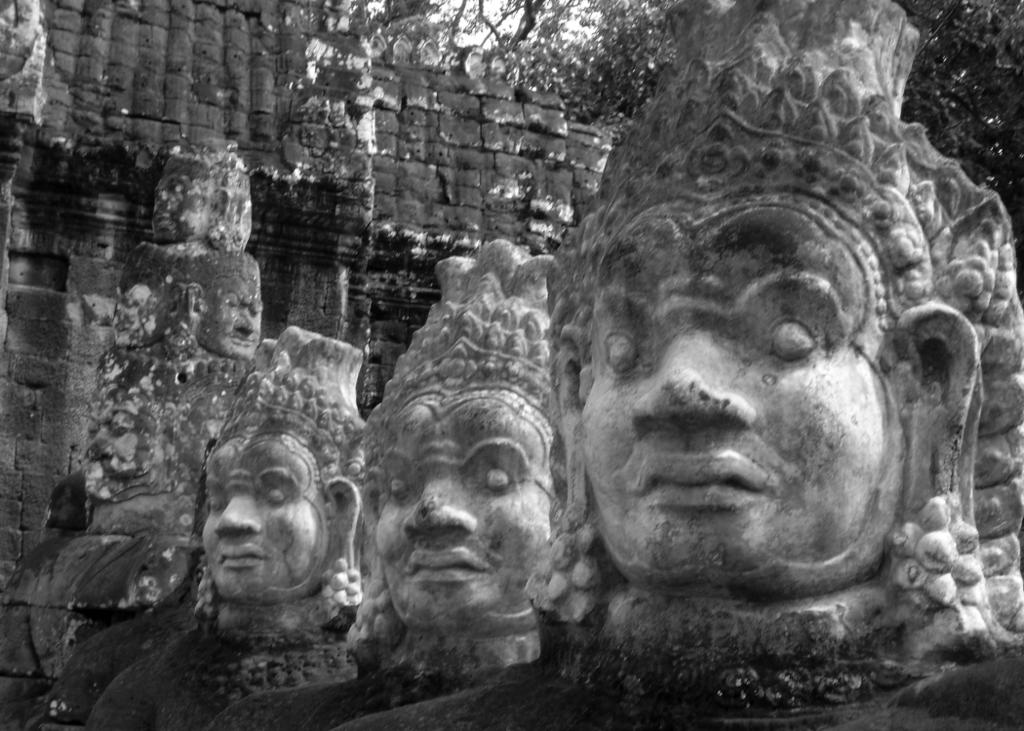
The Enlightened eyes of the 54 devas, or lesser gods, gaurding the gate of Angkor Thom.

Walking along the narrow road to Angkor Thom, dodging motor bikes and bicycles, a long line of elephants appeared in the shade of the jungle, camouflaged in the shadows of leaves. I watched them as I walked along, until when I finally turned my head I saw a massive stone gate rising up like a mountain, from the peak of which I found a face staring back at me, and two more surveying the jungle in each direction. I came to the foot of a bridge over a large moat, once filled with alligators to detour trespassers like myself. I crossed the causeway, encouraged by the serene smiles of 54 devas on my left, though from my right I felt the heavy stare of 54 demons. Peering down from above, the omniscient eyes of the gatekeeper seemed to watch my every step. I felt as if I were passing through the oracle in the Never Ending Story.

The watchful eyes of Angkor Thom's demons.

Image hosted by Photobucket.com
Niether the gate of Angkor Thom, nor the eyes of its gaurdians, can prepare you for the jewel of the jungle: Bayon.

The Faces of Bayon

Image hosted by Photobucket.com
When Zhou Daguan visited Angkor in 1297-98, Bayon's towers were covered in gold. While Angkor Wat was kept from the ravages of the jungle by devoted Buddhist monks, Bayon was forgotten, left to the mercy of nature.

From a distance, it seemed the jungle had taken its revenge on the eerie mass of jumbled rocks known as Bayon. I approached it in awe as hundreds of faces began to emerge from the tangled mass of stone and shadow. 54 towers chaotically assaulted the sky, each in its own plain, creating an intimidating sense of height.

When Chinese ambassador Zhou Daguan visited Angkor before the dawn of the 14th century, the city was dripping with the gold and riches of empire.

Image hosted by Photobucket.com

"At the center of the Kingdom rises a Golden Tower flanked by more than twenty lesser towers and several hundred stone chambers," Zhou wrote.

"On the eastern side is a golden bridge guarded by two lions of gold, one on each side, with eight golden Buddhas spaced along the stone chambers."

The"golden" period of the Khmer Empire was not a peaceful one. Rival powers from present-day Vietnam, Thailand, and Burma struggled with the Khmers for regional domination. Ironically, the Khmers' architectural prowess aided in their demise, as extensive temple construction, combined with frequent military conflicts, eventually drained the empire's resources. As the empire declined, Angkor was sacked several times, the gold and jewels stripped as spoil by invading armies. Bayon was one of the last great achievements of the empire, but fell in 1432 to the Thais, and was soon after forgotten.

The gold and jewels may be gone, but the mystique and grandeur of the Khmer kingdom endures.


A translation of King Jayavarman VII`s mystic Buddhist beliefs, Bayon is a spiritual experience. From each of the survivng towers the enlightened grin of the Boddhisattva Avalokitesvara, one of the most worshipped divinities in Mahayana Buddhism and the kingdom's principal divinity, compassion radiates out in the four cardinal directions. Carved in the likeness of the King himself (his portrait is known from other sculptures found elsewhere in Cambodia and Thailand), these enigmatically smiling faces portray the King as god, symbolizing his omnipresence and omnipotence.

Image hosted by Photobucket.com
The Khmer Smile.

Bodhisattva Avalokitesvara is believed to be the embodiment of compassion. A bodhisattva is motivated by compassion to seek enlightenment for all beings. The 216 faces haunting the heights of Bayon project benevolence outward in all directions, and are believed to bring hope, happiness, peace, and protection to all, especially those living in the Khmer Empire.


As I wandered around in wonder, watched by the eyes of Big Brother, Bayon-style, I couldn't help but feel like I was trapped in an MC Escher drawing. I don't think I could ever have believed such a place existed, even in my dreams, and I certainly never imagined that someday I would see it with my own two eyes.


Hungry Ghosts of Pchum Ben


My last night in Phnom Pen seemed it would end all too soon after leaving a popular local night club called Spark. I sat, side-saddled, on the back of my friend's motorbike, as we toured the quiet city's mostly empty streets. By the bright lights that illuminated the Royal Palace, I was amazed at the amount of people still awake. Children ran and played as women sold brightly colored fruits and vegetables, while young people hung out. Couples lined the bank of the Mekong River along the Sisowath Quay, and the sidewalks were crowded with the tuk-tuks and motorbikes that had flooded the streets during the day, their drivers curled up beneath their tuk-tuk canopies or balanced along the seat of their bikes, feet crossed, up on the handle bars, catching a few winks before their work began again.
In front of a temple gate I noticed many large groups of people gathering. Young girls were selling plates of brightly colored sweets on mounds of tiny rice balls, decorated with white blossoms and a long stick, planted deeply in the sticky rice, from which hung a paper ornament in the ghostly shape of a person. Curiosity peaked, I asked my friend to stop, and as we slowed down across the street from the temple, the girls ran to us, eager to make a sale. Glancing over their heads I saw enormous crowd filling the street, headed towards the temple, bathed in the unnatural glow of a streetlight. My friend explained that these people had come to celebrate Pchum Ben, the festival of hungry ghosts.

I bought a thin, aluminum platter stacked with small rice balls, flower shaped sweets and two lilies and walked into the temple grounds to sit outside the doors with many of the people hoping to get a good seat for the service. From the moment I passed through the gate I felt and met the eyes of all the people gathered turn towards me in shock and amazement. For the first time in my life I felt out of place, as if my presence was completely unexplainable. Since I knew neither the language nor the custom of the people who wondered at me, I could not help but lower my eyes and stay close to my friend.

A small crew of children followed me to where I sat down, and then stood before me, tilting their heads this way and that, trying to figure me out. Finally they began to smile and giggle before working up the courage to use what little English they knew to introduce themselves: "My name Ran," smiled a small boy, pointing to himself. "My name Dalin," he said, pointing to another. We giggled together, struggling to make sense of one another, until the creaking sound of the great wooden doors of the temple slowly swinging open cut through our laughter and drew my attention to the temple, which seemed to gasp for air as 3 young monks in saffron colored robes subdued in tone by the cover of night struggled to pull them open for the visitors.

We joined the crowd, followed by the children, who's hands I found laid upon my feet as we reached the door, fighting over which of them would watch over them, hoping, as my friend later told me, that they might earn some money in doing so. They did not pass through the doors, but sat, squatting at the threshold, arranging the growing jumble of empty shoes into rows and columns. After checking my shoes at the door, I half expected to feel the smooth, cool, woven texture of tatami beneath my feet as we entered the temple, but instead I turned to see the entire room covered in bright red carpet. At the front of the hall was a large golden buddah, framed by four golden columns, connected by strands of Christmas lights. Behind the buddah's head was a psychedelic, swirling, neon-colored something that looked like it belonged beneath a black light. When I mentioned the difference between this buddah and the ones I had seen in Japan, my friend proudly replied "Ah, yes. We use technology!"

On the far left hand side of the room, the monks began to trickle in, taking their place in neatly arranged lines on the floor, facing the growing audience. They seemed to be shaking off the sleep still thick in their eyes, as I began to feel mine grow heavy. By this time people had packed the temple tight, and were standing along the walls and crowded outside the open door, filling the courtyard. A monk began to chant. It was 4 Am.

The beat of the drum led them in their song, so calming I nearly fell asleep on the shoulder of my friend, until the women behind me pulled one of my toes and explained to us both, in Khmer, how improper it was since he was a boy. I was horribly ashamed, and fought with all my might to sit straight up with my palms pressed together, making my own prayers as the monks led the congregation in reciting theirs. When the chanting finished I opened my eyes to see the monks shifting themselves to face a new direction before starting all over again. If I had not been struggling to keep myself from falling asleep and further disgracing myself, I would have paid much closer attention, but all I remember is struggling to get back up to my feet as people around me picked up their plates of food, many with sticks of incense or candles burning on them, and flowed around me towards the door.

Framed by the open doors I could see the courtyard full with people, their faces dimly lit by the candles of their offerings, as they began to make three loops around the temple, crammed with hundreds of other devotees. The small children that had promised to keep watch of our shoes appeared at my feet, arranging my shoes for me to slip easily into as I joined in journey through the grounds, surrounded by the melting candles, sweet scent of incense and haunting paper spirits, which floated in the gentle wind of the bustling crowd. Each time we reached one of the 8 compass points, the people joyfully threw bay ben, a mixture of sticky rice, black beans, sesame and coconut milk, as an offering to the hungry ghosts of their ancestors, believed to return to earth during these 15 days, during which time their prodigy can ease their suffering.

With over 50% of the population under the age of 20, it is no doubt that this festival carries the weight of remembering all those who died under the genocidal reign of terror imposed by the Khmer Rouge, which killed more than 2 million people, about a third of Cambodia's population at that time, between 1974-79.
I could not stay to make the 3 circumnavigations of the temple before the sunrise called the spirits back to the other world, for soon it would call me away as well, down the Mekong River to the last stop on my journey: Viet Nam.