


SEOUL, Jan 18 (Reuters) - As of 0117 GMT, the main KOSPI was up 0.47 percent at 2,109.63 points. The index opened up 0.19 percent at 2,095.85 points. Stocks on the move on Tuesday include: **MEMORY CHIP ISSUES RALLY ON ELPIDA REPORT** Memory chip makers Samsung Electronics Co Ltd and Hynix Semiconductor Inc advanced firmly after the Nikkei business daily reported that Japan's Elpida Memory Inc planned to raise prices of DRAM chips used in personal computers by about 10 percent as early as this month. Samsung Electronics, the world's No.1 memory chip maker, rose 2.21 percent to 970,000 won after hitting a fresh historical high of 972,000 won.
Hynix Semiconductor, the world's No.2 memory chip maker, advanced 3.5 percent. "The report of Elpia's price rise plan points to similar moves by domestic memory chip makers and strengthens sentiment towards the sector," said Daewoo Securities analyst James Song. "DRAM prices are expected to continue to recover this year." 0117 GMT (Reporting by Jungyoun Park; Editing by Chris Lewis) ((jungyoun.park@thomsonreuters.com; +82 2 3704 5643; Reuters Messaging: jungyoun.park.reuters.com@reuters.net)) Keywords: MARKETS KOREA HOT/ (If you have a query or comment on this story, send an email to news.feedback.asia@thomsonreuters.com) COPYRIGHT Copyright Thomson Reuters 2011. All rights reserved.
The copying, republication or redistribution of Reuters News Content, including by framing or similar means, is expressly prohibited without the prior written consent of Thomson Reuters.
Showing posts with label khmer news. Show all posts
Showing posts with label khmer news. Show all posts
Monday, January 17, 2011

Japan Hot Stocks-Steelmakers, Yoshinoya, Elpida
TOKYO, Jan 18 (Reuters) - The benchmark Nikkei average rose 0.1 percent and the broader TOPIX was 0.3 percent higher on Tuesday. The following stocks were on the move: **NIPPON STEEL, JFE DOWN ON OUTLOOK REPORT** Shares of Nippon Steel and JFE Holdings fell after the Nikkei business daily said the steelmakers' profits are likely to undershoot their forecasts for the year ending in March, due to rises in iron ore and coal prices. Nippon Steel lost 1.7 percent to 292 yen and JFE fell 1.7 percent to 2,779 yen. The Nikkei said Nippon Steel's recurring profit is expected to be around 220 billion yen for the current financial year, about 30 billion yen lower than its forecast, while JFE's recurring profit may total around 200 billion yen, missing its forecast by 20 billion yen. 0125 GMT **YOSHINOYA JUMPS ON STAKE BUYBACK FROM ITOCHU** Shares in Yoshinoya Holdings Co jumped 3.3 percent to 109,400 yen after the fast food restaurant operator said it plans to become the largest holder of its own shares by buying back the 21 percent stake owned by trading house Itochu Corp for around 14 billion yen ($169.4 million). The move will beef up Yoshinoya's holding to 25.7 percent from 4.7 percent, it said in a statement. Itochu's shares were 0.6 percent higher at 911 yen. 0028 GMT **ELPIDA MEMORY RISES ON DRAM PRICE HIKE PLAN REPORT** Shares of Elpida rose 2.9 percent to 1,116 yen after the Nikkei business daily reported it plans to raise prices of personal computer DRAMs by about 10 percent as early as this month. DRAMS are selling for about one-third of what they did a year ago, it said. Elpida, which is looking for an earnings turnaround, reckons that conditions are right for a price hike, the daily said, adding that of all types of DRAMs, the PC variety is said to have fallen the most in price. 0012 GMT (For IPO news, data and diary, click, for stocks click) (Reporting by James Topham; Editing by Edwina Gibbs) ((james.topham@thomsonreuters.com; +813 6441 1858; Reuters Messaging: james.topham.thomsonreuters.com@reuters.net)) ((If you have a query or comment on this story, send an email to news.feedback.asia@thomsonreuters.com)) Keywords: MARKETS JAPAN STOCKS HOT (Multimedia versions of Reuters Top News are now available for: * 3000 Xtra : visit http://topnews.session.rservices.com * BridgeStation: view story .134 * Reuters Plus: from your WebDSS screen For more information on Top News, visit http://topnews.reuters.com) COPYRIGHT Copyright Thomson Reuters 2011. All rights reserved.
The copying, republication or redistribution of Reuters News Content, including by framing or similar means, is expressly prohibited without the prior written consent of Thomson Reuters.
The copying, republication or redistribution of Reuters News Content, including by framing or similar means, is expressly prohibited without the prior written consent of Thomson Reuters.
PRESS DIGEST - Thai newspapers - Jan 18
BANGKOK, Jan 18 (Reuters) - These are some of the leading stories in Thai newspapers on Tuesday. Reuters has not verified these stories and does not vouch for their accuracy. BANGKOK POST - Sahaviriya Steel Industries Pcl (SSI), Thailand's largest hot-rolled steel producer, may seek a listing on the London Stock Exchange in its bid to become an international company. - Soft drink sales at Serm Suk Pcl, the local bottler of Pepsi, Mirinda and 7-Up, grew by 9 percent last year, beating industry growth of 6 percent despite shareholding conflicts with trademark owner PepsiCo. THE NATION - Thailand's economy could show a steep growth rate of as much as 6 or 7 percent this year, if there were no political protests to erode investor confidence, according to Thai Chamber of Commerce Chairman Dusit Nontanakorn. - Krung Thai Bank Pcl and TMB Bank Pcl will be behind the 38.5 billion baht bridge loan needed by Big C Supercenter Pcl to purchase the Carrefour business in Thailand. - Chinese enterprises are boosting their investments in Thailand in a big way, with the first of three joint ventures with Thai partners being a sprawling wholesale trading centre worth 28.8 billion baht near Bangkok. - TOT Pcl will announce by Wednesday the names of the qualified bidders for the roll-out of its nationwide third-generation wireless telecom network worth 17.44 billion baht ($571 million). KRUNGTHEP THURAKIJ - Cambodia's Appeal Court is expected to decide today whether to grant bail to five Thais being held in Prey Sar prison on trespassing charges. - Thitikorn Pcl expected motorcycle sales growth in Thailand of 5 percent, saying rising interest rates would not hurt its operating performance. ($1=30.53 Baht) Keywords: THAILAND PRESS/ (Bangkok Newsroom +66 2648 9721, e-mail: bangkok.newsroom@reuters.com) COPYRIGHT Copyright Thomson Reuters 2011. All rights reserved.
The copying, republication or redistribution of Reuters News Content, including by framing or similar means, is expressly prohibited without the prior written consent of Thomson Reuters.
The copying, republication or redistribution of Reuters News Content, including by framing or similar means, is expressly prohibited without the prior written consent of Thomson Reuters.
Singapore Hot Stocks-SGX falls slightly on missed Q2 earnings
SINGAPORE, Jan 18 (Reuters) - Shares of Singapore Exchange , Asia's second-largest listed bourse operator, fell as much as 0.47 percent on Tuesday after it posted lower-than-expected quarterly earnings. At 0135 GMT, Singapore Exchange was down 0.24 percent at S$8.41 with 272,000 shares changing hands. SGX reported an adjusted 14 percent rise in October-December profit, as a jump in technology spending partially offset higher securities turnover. The company said it earned S$81.7 million ($63.5 million) adjusted net profit in October-December, compared with S$71.8 million a year ago. Analysts had forecast an average S$84.7 million net profit for the company's second quarter, according to a Reuters survey of five analysts. "Their latest earnings are unexciting. Going forward, there's still uncertainty about the merger with ASX, so SGX's shares are likely to be capped by that," said a local trader. (Reporting by Charmian Kok) Keywords: SINGAPORE MARKET STOCKS/SGX (charmian.kok@thomsonreuters.com)(+65 6403 5666)(Reuters Messaging: charmian.kok.reuters.com@reuters.net) COPYRIGHT Copyright Thomson Reuters 2011. All rights reserved.
The copying, republication or redistribution of Reuters News Content, including by framing or similar means, is expressly prohibited without the prior written consent of Thomson Reuters.
The copying, republication or redistribution of Reuters News Content, including by framing or similar means, is expressly prohibited without the prior written consent of Thomson Reuters.
Maven Semantic: Tropical Medicine Research Database Search Over 30,000 People and Over 2,000 Tropical Medicine Research Organisations
The new database is now available to marketing, business development, competitor intelligence, KOL, medical affairs and related departments in the life sciences sector.
The database currently tags 30,000 individuals working in Tropical Medicine.
http://bit.ly/hgEV5K.
Top 10 Countries for Tropical Medicine Research (ranked by number of senior Tropical Medicine researchers) United States Of America (5,865) United Kingdom (4,256) Thailand (1,697) Japan (1,193) Germany (1,053) India (1,049) Brazil (919) France (707) Nigeria (626) Belgium (608) Leading organisations in Tropical Medicine research include: Addis Ababa University Ain Shams University All India Institute of Medical Sciences Armed Forces Research Institute of Medical Sciences Bernhard Nocht Institute for Tropical Medicine Case Western Reserve University Centers for Disease Control and Prevention Centre for Clinical Vaccinology and Tropical Medicine Centre for Tropical Veterinary Medicine Chiang Mai University Chulalongkorn University Churchill Hospital Harvard School of Public Health Hospital for Tropical Diseases Imperial College London Indian Council of Medical Research Institut Pasteur Institute for Tropical Medicine Instituto Oswaldo Cruz James Cook University John Radcliffe Hospital Johns Hopkins University Kagoshima University Kenya Medical Research Institute Khon Kaen University King Saud University Liverpool School of Tropical Medicine London School of Hygiene & Tropical Medicine Mahidol University Medical University of Vienna Nagasaki University National Center for Infectious Diseases National Defense Medical Center National Institutes of Health Papua New Guinea Institute of Medical Research Prince Leopold Institute of Tropical Medicine Prince of Songkla University Queensland Institute of Medical Research Research Institute for Tropical Medicine Swiss Tropical Institute Tri-Service General Hospital Tropical Medicine Research Institute Tulane University School of Public Health and Tropical Medicine Universidad Peruana Cayetano Heredia Universiti Sains Malaysia University of Ibadan University of Khartoum University of Malaya University of the West Indies University of Tubingen University of Washington Walter Reed Army Institute of Research Washington University School of Medicine Yale University School of Medicine Yonsei University College of Medicine The database also includes pharmaceutical companies, biotech companies, CROs, hospitals, government labs and other organisations active in the Tropical Medicine research field.
What is Maven: - Largest database of international medical professionals, with over 6,000,000 people and over 500,000 medical organisations; - All records are downloadable to excel or in-house database, with email, postal address and phone contacts; - Profile and segment the entire database using over 47,000 diseases and therapeutic areas For more information visit http://www.mavensemantic.com/.
SOURCE: Maven Semantic CONTACT: Maven Semantic Bryan McManmon, +353 1 4100699 bryan.mcmanmon@mavensemantic.com Copyright Business Wire 2011 -0- KEYWORD: United Kingdom
United States
Belgium
Brazil
Nigeria
France
Germany
India
Thailand
Japan
Europe
Asia Pacific
North America
South America
Africa INDUSTRY KEYWORD: Education
University
Health
Biotechnology
Pharmaceutical
Professional Services
Other Professional Services
Communications
Marketing
Research
Science
The database currently tags 30,000 individuals working in Tropical Medicine.
http://bit.ly/hgEV5K.
Top 10 Countries for Tropical Medicine Research (ranked by number of senior Tropical Medicine researchers) United States Of America (5,865) United Kingdom (4,256) Thailand (1,697) Japan (1,193) Germany (1,053) India (1,049) Brazil (919) France (707) Nigeria (626) Belgium (608) Leading organisations in Tropical Medicine research include: Addis Ababa University Ain Shams University All India Institute of Medical Sciences Armed Forces Research Institute of Medical Sciences Bernhard Nocht Institute for Tropical Medicine Case Western Reserve University Centers for Disease Control and Prevention Centre for Clinical Vaccinology and Tropical Medicine Centre for Tropical Veterinary Medicine Chiang Mai University Chulalongkorn University Churchill Hospital Harvard School of Public Health Hospital for Tropical Diseases Imperial College London Indian Council of Medical Research Institut Pasteur Institute for Tropical Medicine Instituto Oswaldo Cruz James Cook University John Radcliffe Hospital Johns Hopkins University Kagoshima University Kenya Medical Research Institute Khon Kaen University King Saud University Liverpool School of Tropical Medicine London School of Hygiene & Tropical Medicine Mahidol University Medical University of Vienna Nagasaki University National Center for Infectious Diseases National Defense Medical Center National Institutes of Health Papua New Guinea Institute of Medical Research Prince Leopold Institute of Tropical Medicine Prince of Songkla University Queensland Institute of Medical Research Research Institute for Tropical Medicine Swiss Tropical Institute Tri-Service General Hospital Tropical Medicine Research Institute Tulane University School of Public Health and Tropical Medicine Universidad Peruana Cayetano Heredia Universiti Sains Malaysia University of Ibadan University of Khartoum University of Malaya University of the West Indies University of Tubingen University of Washington Walter Reed Army Institute of Research Washington University School of Medicine Yale University School of Medicine Yonsei University College of Medicine The database also includes pharmaceutical companies, biotech companies, CROs, hospitals, government labs and other organisations active in the Tropical Medicine research field.
What is Maven: - Largest database of international medical professionals, with over 6,000,000 people and over 500,000 medical organisations; - All records are downloadable to excel or in-house database, with email, postal address and phone contacts; - Profile and segment the entire database using over 47,000 diseases and therapeutic areas For more information visit http://www.mavensemantic.com/.
SOURCE: Maven Semantic CONTACT: Maven Semantic Bryan McManmon, +353 1 4100699 bryan.mcmanmon@mavensemantic.com Copyright Business Wire 2011 -0- KEYWORD: United Kingdom
United States
Belgium
Brazil
Nigeria
France
Germany
India
Thailand
Japan
Europe
Asia Pacific
North America
South America
Africa INDUSTRY KEYWORD: Education
University
Health
Biotechnology
Pharmaceutical
Professional Services
Other Professional Services
Communications
Marketing
Research
Science
Tuesday, November 23, 2010
Wednesday, September 22, 2010
Advisor to Cambodia's PM apologizes for making statue
 Mea Culpa: Om Yentieng (Photo: John Vink/Magnum)
 An advisor to Cambodia's Prime Minister Hun Sen has apologized for making a statue without permission. In a letter made available to the media on Friday, Om Yintieng, advisor to Prime Minister Hun Sen said he had made a statue of the Prime Minister in a way to express his respect and gratitude, but without knowledge or consent from him. He thus made a public apology and asked for forgiveness from the premier. Om Yintien made the apology soon after the Cabinet of Prime Minister Hun Sen issued a statement on Thursday saying a number of places have been displayed with statues of the country's leaders or certain artists make sculpture or reproduction in objects of the leaders for decoration at homes or as souvenirs. The statement said the gesture has affected the country's tradition and culture which does not allow any statue or sculpture of the leaders be displayed while they are still alive. In the letter of apology, Om Yintieng did not mention the details of Hun Sen's statue that he had built and where exactly it will be displayed, but local media has reported Friday saying the premier's statue was designed for display inside the premise of government's anti-corruption unit, where is chaired by Om Yintieng. The statue which was seen Thursday by reporters under the wraps was already removed from the site on Friday.
* News * World news * Cambodia Cambodia garment workers strike for minimum wage hike
 A Cambodian worker addresses colleagues outside a garment factory in Phnom Penh. Photograph: Tang Chhin Sothy/AFP/Getty Images
 Strikes by about 200,000 Cambodian textile workers – mainly women – in the capital Phnom Penh and the provinces, in protest over low wages, were suspended after three days last week.
The action followed the announcement in July that the minimum wage for workers in the garment and footwear industry would rise from $50 to $61 a month. The level of the rise outraged trade unions, prompting demands for $93 a month.
Last week's industrial action ended peacefully, but strikers threatened to further action if their demands were not met. "We are not demanding a minimum wage, we want a living wage," said Ath Thorn and Kong Athit, of the Cambodian Labour Confederation.
Their demands are supported by a study published last year by the economist and head of the Cambodian Development Institute Kang Chandararot. He said garment workers could only make a living by doing overtime so were closely dependent on the economic climate. He proposed a viable minimum wage of $90.
Cambodia was hard hit by the international crisis in 2008. Textile exports to the US and Europe, the country's main markets, fell by 23% in 2009. More than 90 factories, often owned by Chinese or Taiwanese operators, closed, laying off about 60,000 workers out of a total of 345,000 in the trade. Conditions in the first half of 2010 have improved, with a 7% increase in exports, but business is still far below its level three years ago. Above all there is still no overtime, prompting the massive strike turnout.
"New demands are surfacing now, after two relatively quiet years, because the worst of the crisis is past and exports are picking up," said Jean-Raphaël Chaponnière, an economist at France's Development Agency (AFD).
François-Marie Grau, the General Secretary of the Women's Clothing Federation in Paris, endorses this view. "What is happening in Cambodia is symptomatic of widespread upward pressure on manufacturing costs all over Asia. The region is enjoying powerful growth so workers are putting pressure on their employers," he said.
Friday, September 17, 2010
Hun Sen Expects October Sideline Talks With Thai Premier

Thailand's Prime Minister Abhisit Vejjajiva, left, greets Prime Minister Hun Sen during their meeting in Hua Hin, Thailand, on April 4, 2010.
Both sides are at loggerheads over a small stretch of land west of the ancient temple, but they only just resumed diplomatic ties that have been suspended since late 2009.
Both sides had withdrawn their ambassadors over a separate incident, when Cambodia hired Thailand's fugitive ex-premier Thaksin Shinawatra as an economic adviser, incensing Bangkok.
Hun Sen told a graduation ceremony of students at the National Education Institution Wednesday that he expected to see Abhisit Vejjajiva on the sidelines of the Brussels meeting as a matter of course.
Other chances to talk could include an Asean summit in Vietnam later in October and a Mekong countries economic meeting in Cambodia in November.
Talks between the two premiers could focus on the border dispute, but also investment, trade, transportation, environmental protection along the border, transnational crime or regional pandemic, Hun Sen said.
Hun Sen said he was disappointed that Thailand still had troops occupying a small pagoda near Preah Vihear temple that is at the heart of the dispute. Thailand claims the pagoda was built on Thai soil. Both sides have reported thousands of troops amassed along the northern border.
“As long as Thai soldiers have not withdrawn from Cambodian territory, the relations are not normal,” he said.
He also stressed the need for a resolution to the ongoing problem, which could require third-party mediation, a step Thailand has said is not necessary.
“Cambodia cannot wait for so long,” Hun Sen said.
Siem Reap (Cambodia), Sept 17 (IBNS) Remarks of Indian President Pratibha Patil at a banquet hosted by the Governor of Siem Reap Province on Thursday:
I deeply appreciate the warm hospitality extended to me and my delegation. I am delighted to be in the historical city of Siem Reap which is home to so many magnificent monuments including the world heritage site - Angkor Wat. These monuments reflect the glory of the Khmers at that time and are a visible symbol of strong cultural ties that existed between India and Cambodia.
India is proud to have been involved in the conservation and restoration efforts of Angkor Wat from 1986 to 1993 and is currently working for Ta Prohm Temple. Today, I had the honour of laying the foundation stone for MGC Asian Traditional Textiles Museum, which would be an added testament of Indian cultural cooperation between India and member countries of the Mekong Ganga Cooperation in this beautiful city of Siem Reap.
I see such joint initiatives as proof of the desire of the two Governments to keep alive the historical cultural ties that exist between the two countries.
I wish to commend Your Excellency, the Governor of Siem Reap Province, and your officials, for their untiring efforts in making the city as well as the Angkor area a tourist paradise. vExcellency, Ladies and Gentlemen, may I invite you to join me in a toast:
- to the age old friendship between India and Cambodia; - to the progress and prosperity of the people of Cambodia; and
- to the historic city of Siem Reap and to the World Heritage site of Angkor Wat.
Man About Town 17-09-2010
 Friday, 17 September 2010 15:00 Peter Olszewski
We’re used to seeing unusual events staged at Angkor Wat, and now the temple will be graced with a tennis court – but only for a day.
An AstroTurf tennis court will be set up in front of Angkor Wat on September 28 by online service provider Ezecom in conjunction with the Tennis Federation Cambodia.
A move is afoot to resurrect Cambodia’s tennis legacy, which was lost during the Khmer Rouge era and has never since enjoyed the upper-class popularity tennis had in the Kingdom in the 1960s. The Ezecom promotion is part of this push.
The tennis court at Angkor Wat will, on the day, be the stage for Indian tennis great, Leander Paes, a Wimbledon title winner and former captain of the Indian Davis Cup team. He will demonstrate his prowess and conduct a workshop for junior federation members.
CNN will also be in town at the time filming a documentary, and the plan is to have footage of the tennis action at Angkor featured.
London photo showing
The NGO Anjali House, founded in 2006 by the Angkor Photography Festival Association, is about to build some serious brand recognition in London.
Some of the the Anjali House children’s photographs from last year’s festival workshops will be complementing the launch of a book at Asia House in London on September 30.
The evening will include readings from author Sue Guirney’s new book set in Cambodia, accompanied by projections of the children’s photography.
Anjali will be represented on the night by Mr Boris T Van, who will make a short presentation on the work of Anjali House.
Meanwhile, The Angkor Photo Festival coordinator Camille Plante undertook her annual migration from Paris on Monday, and is now ensconced in Siem Reap. As usual, the French dynamo is busily preparing for this year’s festival, which will run from November 20-27.
Blake is coming
Times have been set for Fragments, the bronze sculpture exhibition by the renowned artist Blake, next Thursday, September 23. Blake will give a talk at 6.30pm at the Hotel de La Paix’s Arts Lounge, and then another of the hotel’s famed receptions will kick off, lasting until 10pm.
PHNOM PENH, Cambodia, Sept. 17 (UPI) --
The second in command of Cambodia's deadly Khmer Rouge regime during the 1970s will stand trial next year charged with genocide, torture and religious persecution.
In the dock will be Nuon Chea, who, as deputy to Khmer Rouge leader Pol Pot, was the second most powerful person in the regime that lasted from 1975-79.
An estimated 1.7 million Cambodians -- one-fifth of the population -- lost their lives under the regime, which was overthrown by an invading army from neighboring Vietnam in 1979. Hundreds of thousands of Cambodians fled the country into exile and uncertain refugee status.
The Khmer Rouge abolished religion, schools and currency to create an agrarian utopia through forced migration from the cities into the countryside. But most are believed to have died of starvation, overwork or were executed by government officials and the military.
Chea, 84, will be joined by three other senior Khmer Rouge leaders, all indicted by Cambodia's U.N.-backed war crimes tribunal. Facing the same charges are former head of state Khieu Samphan, former Foreign Minister Ieng Sary and his wife Ieng Thirith, who was the regime's social action minister.
Chea is believed to have been a key architect of the regime's mass killing strategy. He has acknowledged that deaths took place but denies he had any authority to stop them.
Ieng Sary, 84, was the former minister of foreign affairs. He was found guilty of genocide in a Vietnamese-backed trial of former leaders in 1979.
Ieng Thirith, 78, studied English literature in Paris and was Pol Pot's sister-in-law.
Khieu Samphan, 79 and also French-educated, was one of the regime's few diplomats who had contact with the outside world because he was officially head of state.
There were fears that the trial, expected to be one of the most complicated genocide trials, wouldn't happen.
The four Khmer Rouge leaders were arrested in 2007 and have consistently denied the charges that include torture, rape and murder. The tribunal judges were facing a Sept. 19 deadline to hand down indictments or release them.
The court has decided to "send forward these four accused for trial," Judge You Bunleng said at a news conference.
The trial of the four leaders is the second such trial for the country that still feels the pain of what became known as the "killing fields" because of huge number of deaths and subsequent unearthing of mass graves.
Many families remain traumatized and also in the dark about what happened to their kin and friends after they were forcibly removed to the countryside.
In July the 67-year-old math teacher, Christian convert and Khmer Rouge cadre Kaing Guek Eav was given a 35-year jail sentence for crimes against humanity committed during the regime. It was the court's first guilty verdict against a senior Khmer Rouge party figure.
Eav, commonly known as comrade Duch, was director of the notorious prison and feared interrogation center Tuol Sleng, or S-21, in the capital.
An estimated 16,000 men, women and children were systematically tortured, many beaten to death, at the prison. Cambodian officials say only 14 people survived Tuol Sleng. In particular, Duch is alleged to have ordered the executions of 160 children in a single day.
Judges at the trial of Duch, who is the only one to have shown remorse, reduced his sentence by five years after ruling that he had been illegally detained by a military court following his arrest in 1999. Another 11 years were loped off the sentence because of time served in jail awaiting his trial, meaning he faces 19 years in prison.
Despite his stated remorse, Duch always contended that he was simply carrying out orders from his superiors and did so because he feared for his own life.
The top leader, Pol Pot, fled the country after the Vietnamese invaded in 1979 and he died in 1998.
In the dock will be Nuon Chea, who, as deputy to Khmer Rouge leader Pol Pot, was the second most powerful person in the regime that lasted from 1975-79.
An estimated 1.7 million Cambodians -- one-fifth of the population -- lost their lives under the regime, which was overthrown by an invading army from neighboring Vietnam in 1979. Hundreds of thousands of Cambodians fled the country into exile and uncertain refugee status.
The Khmer Rouge abolished religion, schools and currency to create an agrarian utopia through forced migration from the cities into the countryside. But most are believed to have died of starvation, overwork or were executed by government officials and the military.
Chea, 84, will be joined by three other senior Khmer Rouge leaders, all indicted by Cambodia's U.N.-backed war crimes tribunal. Facing the same charges are former head of state Khieu Samphan, former Foreign Minister Ieng Sary and his wife Ieng Thirith, who was the regime's social action minister.
Chea is believed to have been a key architect of the regime's mass killing strategy. He has acknowledged that deaths took place but denies he had any authority to stop them.
Ieng Sary, 84, was the former minister of foreign affairs. He was found guilty of genocide in a Vietnamese-backed trial of former leaders in 1979.
Ieng Thirith, 78, studied English literature in Paris and was Pol Pot's sister-in-law.
Khieu Samphan, 79 and also French-educated, was one of the regime's few diplomats who had contact with the outside world because he was officially head of state.
There were fears that the trial, expected to be one of the most complicated genocide trials, wouldn't happen.
The four Khmer Rouge leaders were arrested in 2007 and have consistently denied the charges that include torture, rape and murder. The tribunal judges were facing a Sept. 19 deadline to hand down indictments or release them.
The court has decided to "send forward these four accused for trial," Judge You Bunleng said at a news conference.
The trial of the four leaders is the second such trial for the country that still feels the pain of what became known as the "killing fields" because of huge number of deaths and subsequent unearthing of mass graves.
Many families remain traumatized and also in the dark about what happened to their kin and friends after they were forcibly removed to the countryside.
In July the 67-year-old math teacher, Christian convert and Khmer Rouge cadre Kaing Guek Eav was given a 35-year jail sentence for crimes against humanity committed during the regime. It was the court's first guilty verdict against a senior Khmer Rouge party figure.
Eav, commonly known as comrade Duch, was director of the notorious prison and feared interrogation center Tuol Sleng, or S-21, in the capital.
An estimated 16,000 men, women and children were systematically tortured, many beaten to death, at the prison. Cambodian officials say only 14 people survived Tuol Sleng. In particular, Duch is alleged to have ordered the executions of 160 children in a single day.
Judges at the trial of Duch, who is the only one to have shown remorse, reduced his sentence by five years after ruling that he had been illegally detained by a military court following his arrest in 1999. Another 11 years were loped off the sentence because of time served in jail awaiting his trial, meaning he faces 19 years in prison.
Despite his stated remorse, Duch always contended that he was simply carrying out orders from his superiors and did so because he feared for his own life.
The top leader, Pol Pot, fled the country after the Vietnamese invaded in 1979 and he died in 1998.
Vietnam-Cambodia Trade Fair to open
Vietnam-Cambodia Trade Fair 2010 will be held in Battambang, Cambodia, from October 20-24, attracting 150 businesses.
The event is being organised by the Ho Chi Minh City Investment and Trade Promotion Centre.On display in 250 booths will be products in many categories: agriculture, consumer goods, processed food, footwear, cosmetics, interior decoration, textile and garments, and electronics.
During the fair, a survey on three retail markets in Battambang, Cambodia, and a seminar on connecting Vietnamese and Cambodian businesses, tourism promotion, and publicising HCM City’s socio-economic achievements will take place.
The fair has been created to introduce Vietnamese goods to Cambodia’s northwestern region.
When does a massacre become a genocide?
Sep 17th 2010, 11:27 by B.B. | PHNOM PENH
 CAMBODIA’s United Nations-backed war-crimes court formally indicted four former Khmer Rouge leaders on September 16th. Their trial, set to begin next year, will be the second of its kind. In July Comrade Duch, the commandant of an infamous prison, was handed a 35-year sentence for war crimes and crimes against humanity, reduced to 19 years against time served and a period of illegal detention. Next in the dock are the Khmers Rouges’ chief ideologue, Nuon Chea, their former head of state, Khieu Samphan, and Ieng Sary and his wife, Ieng Thirith, both ministers in their government. The four stand charged, like Duch, with war crimes and crimes against humanity—and also with genocide. The court’s new charge should prove most contentious yet.
The term genocide has been used freely by Cambodians and foreign observers alike in reference to the atrocities committed during the Khmers Rouges’ ultra-Maoist revolution. In the mid- to late 1970s it cost the lives of nearly one in four Cambodians; all told, at least 1.7m people died. But the tribunal, started in 2007, only introduced this monumental charge at the end of last year. Investigating judges and prosecutors proposed adding it on the basis of their research into the defendants’ alleged role in the slaughter of Cambodia’s ethnic Vietnamese and Cham Muslims.
In 1999, UN experts concluded that there was strong evidence pointing to genocide by the Khmer Rouge. Ben Kiernan, a scholar of the Khmer Rouge and founder of Yale University’s Cambodian Genocide Project, for one, is adamant that the mass killing in Cambodia constitutes a genocide. In his research Mr Kiernan cites the disproportionate death toll inflicted on those two non-Khmer ethnic groups. The regime officially called for the elimination of both minorities.
Many advocates contend that the symbolic weight carried by the charge of genocide will prove to the Cambodian public that the Western-backed tribunal—known officially as the Extraordinary Chambers in the Courts of Cambodia—acknowledges the gravity of their country’s loss. Theary Seng, a survivor who works as a rights advocate in Phnom Penh, believes there is a strong legal basis for prosecuting the regime’s leaders for genocide. Moreover, she says, it can be an effective means of bringing "gravitas to the tribunal”.
“Genocide” is increasingly being used as a generic label for all the world’s most serious mass crimes. “As a result, the absence of the term ‘genocide’ can be interpreted by survivors as meaning they didn’t suffer as much as others”—ie those who have been deemed survivors of genocide—says John Ciorciari, a lawyer and assistant professor at University of Michigan’s School of Public Policy. He has been tracking the tribunal’s genesis and operations for 11 years in his capacity as a legal adviser to the Documentation Centre of Cambodia, which conducts research for the court.
Despite its growing popularity, the concept of genocide maintains a narrow legal definition which hinges on specific intent. This makes it especially hard to prove. Few dispute that the Khmer Rouge led a campaign to annihilate groups of people whom were considered to be incompatible with its revolutionary aims. The question is whether these groups were targeted first and foremost because of their ethnic or religious type, or rather because they represented perceived political and economic enemies. Somewhat perversely, victims belonging to the latter lot fall outside the crime’s definition.
Not everyone involved with the trial is eager to see the charge introduced. Some have argued that introducing genocide will further entangle a process already beset by delays and confusion. The “Extraordinary Chambers” have already suffered extraordinarily complex internal disputes and accusations of various improprieties, political interference and even outright corruption. One sharply pointed criticism sees the charge of genocide as a cynical move foisted on the proceedings by foreign jurists who want to enhance the profile of the court’s work and their role in it—thereby distracting attention from the Western powers’ history of wrongdoing in Cambodia. “This tribunal has from the beginning been muddled by political objectives,” says Philip Short, who wrote a biography of the late Pol Pot, the Khmer Rouge’s paramount leader.
Many scholars of the Vietnam war blame the American bombing of eastern Cambodia for having driven much of the peasantry into the hands of the Khmer Rouge. America’s role in Cambodia became even grimmer during the 1980s, after the Khmer Rouge were driven from power by a Vietnamese invasion force. In a terrible exercise of cold-war realpolitik, American agents supported the Khmer Rouge in exile as a means of resisting the regime installed by Vietnam.
Or, perhaps, the court is simply following through on its mandate. “The purpose of the tribunal is to adjudicate the most serious crimes,” as Mr Ciorciari says. “To the extent that genocide is distinct from war crimes and crimes against humanity, it’s productive to consider this specific charge.” There is, after all, evidence to support it.
CAMBODIA: Government opens first methadone clinic
 Photo: Brendan Brady/IRIN  |
| Cambodia came under fire earlier this year over its drug treatment services |
Methadone is a heroin substitute used to assuage withdrawal symptoms and for decades has been the treatment method preferred by health practitioners in developed countries, even though it comes with its own addiction problems.
Introduced by the World Health Organization (WHO) and administered by the Ministry of Health, the year-long pilot programme officially launched this week in the capital, Phnom Penh.
"We don't have a strong history of [professional] drug treatment in Cambodia," Chhit Sophal, head of the Ministry of Health's Centre for Mental Health and Drug dependence and in charge of the programme, told IRIN. "This centre can be a model and other centres here can learn from it."
Some 60 patients are already enrolled and Chhit wants the figure to top 100 within a year.
By deterring heroin users from injecting, methadone clears the body of harmful toxins and also prevents the spread of HIV/AIDS and hepatitis from needle-sharing within this high-risk group, said Chhit.
Almost a quarter of Cambodia's estimated 3,000 injecting drug users are HIV-positive, according to the government. This rate is much higher than the national average of less than 1 percent, according to UN statistics.
Graham Shaw, a drug dependence specialist with WHO in Phnom Penh, said the new treatment could turn around the lives of heroin addicts.
"Rather than having your whole life focused on finding money to buy more heroin, you can focus on repairing relationships with family, finding jobs, and using income for things other than drugs," he said.
Shaw said the benefits of clinical treatment would unravel, though, unless other organizations stepped in to help patients find employment and avoid drug-using communities.
Progress and lingering concerns
According to a Human Rights Watch report released in January, drug users were involuntarily interned at government centres where they faced beatings and forced labour, while being deprived of effective treatment for their addiction.
The WHO reported in a publication last year that only one in 405 people in Cambodia entered a drug treatment centre voluntarily.
The methadone programme is a strong step in the right direction, said Shaw. "One of the reasons this clinic is so critical is that it's the first attempt by the government to use a voluntary [rehab] service," he said.
David Harding works with the NGOs Friends International and Mith Samlanh, which refer heroin users to the methadone clinic on a voluntary basis.
He said this more sophisticated therapy was a sign of progress but that the overall picture of the government's rehabilitation protocol remained "mixed", citing the opening of a new state provincial rehab centre that he said used "boot camp" methods.
The government's intentions aside, the country's bigger drug problem, methamphetamine use, remains far more difficult to treat clinically.
The WHO estimates there are some 40,000 methamphetamine users in Cambodia. The international medical community has yet to find a strong antidote to methamphetamine dependence, though.
"That's the Holy Grail, to find the methadone equivalent [for methamphetamine addiction]," said Shaw.
Tuesday, September 14, 2010
Cambodia Opens First Highway Bridge
New Tang Dynasty
The Cambodian Prime Minister officially opened the country's first highway bridge in Phnom Penh on Thursday. With the help of the city's mayor and thousands of onlookers, Prime Minister Hun Sen cut a ceremonial ribbon on top of the structure. Locals at the ceremony shared their excitement. [Him Sokha, Teacher]: "I am very happy that we have the first sky bridge, which we never had before, and our Khmer people can walk and drive on it." [Sam Vanna, Village Chief]: "It is our Khmer pride that we have the first sky bridge, it is a tremendous bridge for our country and I still live to see it. I will bring my wife, children and grandchildren to walk or drive across it later on today to remember the opening day." The bridge cost over 6 million dollars and was created to help ease traffic congestion in the city. The bridge is 1,010 feet long, 17 feet high, and about 47 feet wide. It was completed last month and took one year to build.
A Monk Without a Country
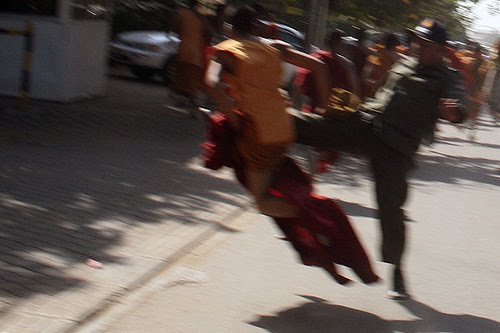 A Cambodian policeman kicking a Khmer Krom monk
 "The best part of the last three years was when I spoke at the United Nations Permanent Forum on Indigenous Issues. All the struggles I have survived, all the pain I have endured, all the tears I have cried were all worth it because for that very moment I knew the world would hear my people’s cry for help. I knew that the world would try to persuade Vietnam to do the right thing by changing their treatment policies toward indigenous people."Born in 1968, Tim Sakhorn is perhaps the most famous Khmer Krom activist alive today. He was granted political asylum in Sweden in July 2009. How does it feel to be reordained? Do you wish you were re-ordained in Cambodia? I am very happy to be a monk again because it has been my way of life, and it has been my culture. Being out of my robe and out of the temple, I feel so lost. I wanted to re-ordain in Cambodia but Freedom of Religion is limited there. In April 2009, upon my release from the Vietnam Government, I came back to Cambodia hoping to seek some justice and re-ordain myself. But I did not receive any; the Cambodian government did not even issue me an identification card. Thus, I was forced to escape from my country and seek refuge in Thailand. If you were to return to Cambodia, would the authorities recognize you as a monk? I don’t think Cambodia government will recognize me as a monk because they are responsible for my arrest, defrock, deportation and imprisonment in Vietnam. I feel unsafe in Cambodia because I am an activist and when you protest, you risk your life. On February 27, 2007, one of my fellow Khmer Krom monks, Ven Eang Sok Thoeun, participated in a demonstration in front of the Vietnam Embassy in Phnom Penh in response to the injustices of the imprisonments in Vietnam. The next morning was found with his throat slit in his own temple. I am just a monk and there is no judicial system to regulate the government, so I am powerless against what the government wants to do. You’ve had a difficult three years, what were the best/worst moments since you were deported in 2007? My last three years of experience has been a life changing one and I know I am fortunate to still have my life. The worst part was not when I was imprisoned with 26 other men, they beating me. It was not when I was beaten, kicked, punched or starved. Not even when they injected me with unknown substances. It was when I sat in my jail cell and realized I have no sovereignty over my own life and my own belief. The Vietnam government has been silencing Khmer Krom people for centuries. And when I tried to stand up, I became one of their prisoners just like many Khmer Krom heroes. It hurt me even more when I realized I was just one of the many voiceless victims. It broke my heart to see how Cambodia Supreme Patriarch monk – Venerable Tep Vong and its government deported me; I thought the government of Cambodia would protect its people and me. But I was wrong; Vietnam and Cambodia were working together and took the human rights away from Khmer Krom people. However, I would not hesitate to go through all the ordeals again because I feel my story would help inform the world of the struggles my people are going through each day; all in the effort to preserve our culture, language, and history. I was lucky to be able to participate in the 9th Session of the United Nations Permanent Forum on Indigenous Issues and through the Youth Caucus my voice and concerns were heard. And to stand up as my concerns were voiced was my best moment of my life. All the struggles I went through, all the pain I have endured, all the tears I have cried were all worth it because for that very moment I knew the world would hear my people’s cry for help. I knew after that moment the world would try to persuade Vietnam to do the right thing by changing their treatment policies toward indigenous people. What have you learned since 2007? I’ve learned that there are certain monks like Supreme Patriarch, Venerable Tep Vong, Venerable Long Kimleang and his fellow monks, Om Lam Heng, Sao Chanthol, Noi Chruek, Cheas OM, who accused me of undermining the relationship between Cambodia and Vietnam, have abandoned their ways of non-violence. They physically forced me to defrock and threw me civilian clothes. It was my first time witnessing and experiencing monks who went against the teaching of Buddhism. We are monks and we believe in non-violence but these monks were equivalent to barbarians. I do not think they should continue the teachings of Buddhism if they themselves can abide by them. I have learned that the Vietnam government has no legal system and transparency to protect the victims of human rights by offering them a fair trial. However on the lighter side, I have learned that there is hope out there for victims of crimes against humanity like myself. There are countries out there that will help. Maybe one day, Krom Krom people can freely believe in what we choose and end the oppression from the Vietnamese Government. What was it like to be in a Vietnamese jail? I was stripped from my position as a monk, deported from a country that I thought would protect me, and I was given an unfair trial in a country that is trying to erase my culture. When I entered that jail cell, I had no hope of every returning home alive because there had been many stories of Khmer Krom prisoners who die in prison. I was beaten, torture, intimidate, and injected with unknown substances still to today I do not know what they have injected me with. The unknown substances num my body and I notice each day I got weaker and weaker. I was a human being, a monk who preached the teachings of Buddhism but once I was defrocked and imprisoned into the Vietnam jail system, I was not a human being anymore. The way they treated me was worst than how they would treat wild animals. I was put into solitary confinement for so long that I could not keep track. The smell, the noise, the dirty atmosphere of the cell is still embedded in my head. I knew that I would never be the same after my experience in that Vietnamese jail cell. I still have nightmares about the place because every minute of my life spent in that cell I thought I was going to die. What are you advocating for? I want my Khmer Krom people to be recognised as the indigenous people of Kampuchea Krom (southern Vietnam). I want Vietnam to respect the fundamental basic human rights such as freedom of religion. I want to see Khmer Krom children have the same opportunity as Vietnamese children. I want to see that our Khmer culture is taught in school and I want to see the Vietnam Government respect and implement the United Nations Declaration on the Rights of Indigenous Peoples (UNDRIP). I would happily give away my life so that future Khmer Krom children can have the right to learn their own culture, so that when people ask them who they are, they can proudly answer that they are Khmer Krom and not lie and answer that they are Vietnamese. Will you continue campaigning? I will continue the struggle for solidarity for Khmer Krom people and seek justice for my people and myself. I am just a single man but I will gladly give away my life so that my culture will have chance to survive. How does it feel to be a symbol of the Khmer Krom advocacy movement? I am lucky to still have my life and continue the struggle to help my people seek justice. But there are many others who face the same problem as me but probably have lost their lives. For over a century my people have been silenced, thus the world does not know us. The world only knows Vietnam and that it is an up and coming country but they do not know the exploitations our Khmer Krom endures. Our land taken away, policy reforms made to benefit the Vietnam Government and our culture reaching a closer step to extinction. When did you receive political asylum in Sweden? I received a political asylum from Sweden in July 2009. Where are you living, what are you doing on a day-to-day basis? Are you working? I am living in Stockholm, Sweden and I attend school every day. I don’t go to work yet and I get my monetary supplement from the Swedish government. The Swedish government has been very supportive and helpful. I am forever in their debt. You were recently re-ordained in the United States. What is your impression of the US, the people, the lifestyle, politics My impression of the United States is that the people seem to be very free. I have never seen people protest freely such like the one I saw in New York City. I dream that one day my people can freely protest and have our issues incorporated into the laws that will dictate our lives. My experience in the US makes Cambodia and Vietnam ways of politics seem primitive. Where we had to keep what we believe hidden, and if we express them like how I did we would risk being imprisoned. There is no open dialogue between the government and the indigenous people like at the United Nations. Do you feel free? How can I feel free when my people back at home are suffering? How can I feel free when I know my culture is slowly dying? When the Vietnam Government recognises Khmer Krom as indigenous people then I would feel free but as of now, I feel more of a victim. I am just a monk without a country. Can you return to Cambodia without fear of retribution? Cambodia does not protect Khmer Krom, Cambodia government is working with Vietnam Government and sometimes they act as one when it’s human right related issue. I return home after my release from the Vietnam, to see if Cambodia government can help me but they did nothing to help. The government promises that if Khmer Krom immigrates to Cambodia they will receive citizenship but in reality it is very far from the truth. Khmer Krom did not receive identification cards and cannot work or vote. But because Cambodia promises to give citizenship to Khmer Krom, we cannot seek refugee status from UNHCR. Cambodia government does not help Khmer Krom and it seems they do not want to help me. I fear for my safety to return to Cambodia because I can easily lose my life. What about your family in Cambodia, will they join you in the States or stay in Cambodia? Yes, they will join in Sweden because they are also in danger of losing their lives. Do you feel cheated? To be honest, yes. The Vietnam government signed “The Declaration on the Rights of Indigenous Peoples” on 13 September, 2007, but they do not respect the declaration. Since the UNDRIP has not been implemented, to me it is nothing more than great set of laws written on a piece of paper. But the world congratulates Vietnam for signing the UNDRIP and yet they have not done anything to live up to their promise. The Vietnam Government continues to deny the status of the Khmer Krom as Indigenous Peoples. What is the future of the Khmer Krom? I do not know what the future holds for Khmer Krom but if the Government of Vietnam continues to deny the status of Khmer Krom as the rightful Indigenous people and the government continues to deny the basic human right such as, freedom or religion, Khmer Krom culture will die. What is in your future? My future is to be monk. I am a Buddhist monk; I want to be a teacher. I can teach Khmer Krom children about Khmer language, history, culture, and peace. Do you have a message for the Cambodian or Vietnamese government? I hope they will do the right thing and recognize the rights of Indigenous people and respect basic human rights. Do you have a message for the people of either country? I wish all Khmer Krom people will continue the struggle to seek our human rights because together we can achieve it. If we don’t do it now, we will never have a better future tomorrow. Each and every day our culture is slowly eroding and we can stop this with solidarity. "The worst part of the last three years was not when I was imprisoned with 26 other men in one cell. It was not when I was beaten, kicked, punched or starved. Not even when they injected me with unknown substances. It was when I sat in my jail cell and realised I have no sovereignty over my own life and my own belief.” Tim Sakhorn is a Buddhist monk and human rights activist who advocates for the rights of southern Vietnam’s ethnic Khmer minority, popularly known as Khmer Krom. The 42-year-old monk was arrested and defrocked in Cambodia in June 2007 before being deported (illegally) and jailed for a year in Vietnam on charges of undermining national unity. At the time, Human Rights Watch said that the politically motivated prosecution of Sakhorn was a thinly veiled attempt by the Vietnamese and Cambodian government to stop peaceful dissent by the Khmer Krom minority in both countries. He reportedly had no legal representation during his trial. “I was given an unfair trial in a country that is trying to erase my culture,” Sakhorn says adding that the Vietnamese refuse to recognise the Khmer Krom as indigenous peoples and actively persecute the minority by forcing them to adopt Vietnamese names and speak Vietnamese. They are also punished for practising their form of Thervada Buddishm and prevented from accessing education and health care. "I knew that I would never be the same again after my experience in the Vietnamese jail.” Sakhorn was born in southern Vietnam, but fled the country with his family when border fighting broke out between the Khmer Rouge and Vietnamese forces in 1978. Like other members of the Khmer Krom minority living in Cambodia, Sakhorn and his family were recognised by the government as Cambodian citizens. But in reality, they are treated like second-class citizens. “Khmer Krom living in Cambodia are not given identification cards and cannot work in many sectors or vote,” he says. In 2002, he was made abbot in Takeo province by Cambodia’s supreme Buddhist patriarch, Tep Vong – the same man who defrocked him five years later. “I’ve learned that certain monks like Venerable Tep Vong and his fellow monks have abandoned their non-violent ways. It was the first time I witnessed and experienced monks who went against the teaching of Buddhism.” Upon his release, he returned to Cambodia but, fearing for his life, he fled to Thailand where he sought political asylum. “I felt unsafe. There is no judicial system to regulate the government.” Sakhorn was granted asylum in Sweden and he is now living in Stockholm. Having been a monk for 17 years he says he was lost when out of his robe, but last month the Buddhist community in Massachusetts re-ordained him. After three years of suffering, he has found his voice again and is hopeful of a promising future. “The best part of the last three years was when I spoke at the United Nations Permanent Forum on Indigenous Issues. All the struggles I have survived, all the pain I have endured, all the tears I have cried were all worth it because for that very moment I knew the world would hear my people’s cry for help. I knew that the world would try to persuade Vietnam to do the right thing by changing their treatment policies toward indigenous people.
Monday, September 13, 2010
Why children in Cambodia need your help
A history of ongoing civil war and unrest has left the landscape of Cambodia scarred with landmines - resulting in thousands of disabilities among children.
 Infant mortality rates are amongst the highest in Asia, and more than one-third of families live below the poverty line. Diseases which can be prevented through immunisation programs are the leading cause of death among children.
Cambodia is also a hub for people trafficking, with the country used as a source, destination and transit point for men, women and children trafficked for the purposes of sexual exploitation and forced labour.
Only since 1998 has some measure of peace prevailed, with the formation of a new coalition government and renewed political stability. The government has also been working with the United Nations to set up a tribunal to try those involved in the genocide of Cambodians. The tribunal commenced in 2007 and testimony is currently being heard.
During the past 10 years, development initiatives have resulted in improving the quality of life of many Cambodians. However, much remains to be done.
Infant mortality rates are amongst the highest in Asia, and more than one-third of families live below the poverty line. Diseases which can be prevented through immunisation programs are the leading cause of death among children.Cambodia is also a hub for people trafficking, with the country used as a source, destination and transit point for men, women and children trafficked for the purposes of sexual exploitation and forced labour.
Country facts
During a three-year period beginning in 1975, an estimated 1.7 million people were killed or died from forced hardships under the Khmer Rouge, led by Pol Pot. The regime was toppled in 1979 when opposition forces took control of the capital Phnom Penh, however, a decade of civil strife followed as the Khmer Rouge resumed guerilla warfare.Only since 1998 has some measure of peace prevailed, with the formation of a new coalition government and renewed political stability. The government has also been working with the United Nations to set up a tribunal to try those involved in the genocide of Cambodians. The tribunal commenced in 2007 and testimony is currently being heard.
During the past 10 years, development initiatives have resulted in improving the quality of life of many Cambodians. However, much remains to be done.
- Population: 14 million
- Capital: Phnom Penh
- Major languages: Khmer (official) 95%, French, English, Indigenous languages
- Major religions: Buddhism, Islam
- Life expectancy: 61 years
Why children in Afghanistan need your help
Afghanistan's recent history has been both turbulent and steeped in conflict - as a result, the country's infrastructure and economy have been left in tatters.
 The country's infant and mortality rates are among the world's highest, and 25 per cent of children die before reaching their fifth birthday. Preventable diseases, such as malaria, measles and acute respiratory infections kill thousands of children each year, and a lack of access to safe drinking water means waterborne diseases also cause more unnecessary deaths.
Safety for women and children in Afghanistan is a major issue, and there is still a large gender gap between boys and girls in the education system, with girls lagging behind. General literacy levels are very low and it's currently estimated that around two million children of primary school age do not attend classes.
Afghanistan has been invaded many times during its long history, but has suffered significantly from the ongoing and brutal civil war that began in the 1970s. This led to an international intervention in 1979 from Soviet forces, and then the 2001 conflict with the US, during which time the ruling Taliban was overthrown. Afghanistan is widely perceived as having major problkmes with governance, seen in its ranking of 176 out of 181 in Transparency International's CPI Index.
Afghanistan's fledgling democratic government now faces the tough challenge of rebuilding a country and also dealing with a renewed upsurgeance in Taliban support. However, extending its power beyond the capital is proving difficult and militant violence has continued. Widespread accusations about vote rigging in the 2009 election have underlined the fragility of the government first elected in 2004.
The country's infant and mortality rates are among the world's highest, and 25 per cent of children die before reaching their fifth birthday. Preventable diseases, such as malaria, measles and acute respiratory infections kill thousands of children each year, and a lack of access to safe drinking water means waterborne diseases also cause more unnecessary deaths.Safety for women and children in Afghanistan is a major issue, and there is still a large gender gap between boys and girls in the education system, with girls lagging behind. General literacy levels are very low and it's currently estimated that around two million children of primary school age do not attend classes.
Country facts
The Islamic Republic of Afghanistan is a landlocked country positioned between the Middle East, Central Asia and the Indian subcontinent.Afghanistan has been invaded many times during its long history, but has suffered significantly from the ongoing and brutal civil war that began in the 1970s. This led to an international intervention in 1979 from Soviet forces, and then the 2001 conflict with the US, during which time the ruling Taliban was overthrown. Afghanistan is widely perceived as having major problkmes with governance, seen in its ranking of 176 out of 181 in Transparency International's CPI Index.
Afghanistan's fledgling democratic government now faces the tough challenge of rebuilding a country and also dealing with a renewed upsurgeance in Taliban support. However, extending its power beyond the capital is proving difficult and militant violence has continued. Widespread accusations about vote rigging in the 2009 election have underlined the fragility of the government first elected in 2004.
- Population: 26 million
- Capital: Kabul
- Major languages: Afghan Persian or Dari (official), Pashtu (official), Turkic languages
- Major religions: Sunni Muslim, Shi'a Muslim
- Life expectancy: 43 years

