Tuesday, August 24, 2010

Tonle Sap: Asia's Great Lake

Daily life in the floating villages of the Tonle Sap.

Southeast Asia’s Mekong River flows thousands of miles from its source in the highland plateau of Tibet to its outlet into the South China Sea. The river runs through China, Myanmar, Laos, Thailand, Cambodia, and Vietnam. The giant river is a valuable, and in some countries a pivotal, natural resource, and has supported hundreds of thousands of people through farming and fishing for centuries.

Cruising through the neighborhood.

Image hosted by Photobucket.com

Among the most interesting features of the river is that monsoon-season rainfall swells the river’s volume so greatly that in low-lying Cambodia, the TonlĂ© Sap (meaning Large Fresh Water River but more commonly translated as Great Lake), one of the Mekong’s southernmost tributaries, is forced to reverse course against the rushing floodwaters. Beginning in June, the roughly 100-kilometer-long (62 miles) Tonle Sap River will begin to be inundated by the rising waters of the Mekong, and will slowly backtrack and begin filling the Tonle Sap Lake. The images above show the Tonle Sap during the dry and wet seasons. Vegetation appears bright green, standing water is dark blue, and clouds are light blue or white. In the bottom scene, the Mekong can be seen flowing in at the top to the right of center, and the Tonle Sap makes a distinct blue splash to the west. By October, much of central Cambodia is underwater (top scene).

Image hosted by Photobucket.com

For most of the year the lake is around one meter deep with an area of 2,700 square km, but during the monsoon season, water is pushed up from the Mekong into the lake, increasing its area to 16,000 square km and its depth to up to nine meters, flooding nearby fields and forests. This provides a perfect breeding ground for fish and makes the Tonle Sap ecosystem one of the most productive inland fisheries in the world, supporting over 3 million people and providing over 75% of Cambodia's annual inland fish catch and 60% of Cambodians' protein intake. At the end of the rainy season, the flow reverses and the fish are carried downriver.

Notice the treetops of the submerged forest shattering the glassy reflection of the lake in the background.

Luckily I chose to visit Cambodia in the midst of monsoon season, while the Lake was at its largest. After an early morning at Angkor Wat to see the sunrise, and an afternoon of temple hopping through the jungle, we decided to take a short cruise on the lake, through the floating villages. As we made our way out of the bustle of tuk-tuks and motorbikes that swarm around Siem Reap's provincial center, the narrow, dirt road wandered through many small neighborhoods, until it was surrounded on both sides by the bank of the river, like a bridge to over time. As we drove through the tiny village that springs up along the edge of the lake during this season, children ran after the bus, waving, laughing, and dragging their friends along with them.

Image hosted by Photobucket.com

On tall, slender stilts, the thatch houses wading in the shallow waters along the banks of the lake towered above the children playing beneath. They ran to us as we made our way to the boats, and even tried to follow us out on the water.


Image hosted by Photobucket.com

While some villagers choose to make their homes on dry land, many more live their lifes on the lake, in floating houses, or in boats.
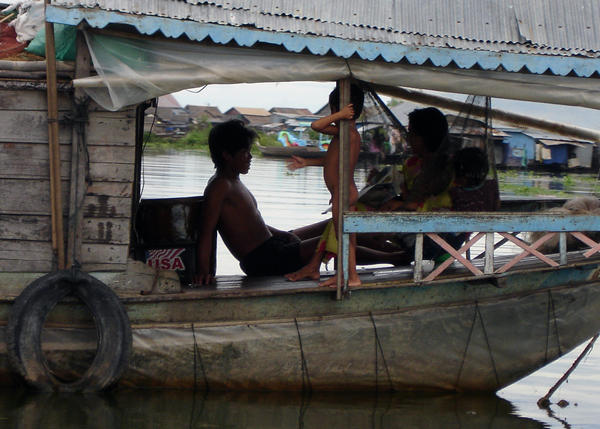

Image hosted by Photobucket.com
A woman bathes outside her floating home. Many of the houses had huddled together closer to shore.

A young boy bathing along the banks.

A man works to repair his boat.
Modern and traditional come togeter along the bloated banks of the Tonle Sap. If Jesus walked on water, I thought, all this man needed was a little faith. With a floating Catholic church nearby, no wonder I turned back to see him to ride off into the sunset on his trusty (soon to be rusty) motorbike.

Image hosted by Photobucket.com
While we were quite far from any of the floating houses, this young girl caught sight of our boat at paddled with a passion to catch up to us.

Image hosted by Photobucket.com
From a distance I could see her tiny body heaving as she struggled to catch her breath, clutching her chest. I watched her the entire time, amazed by her strength and determination. I pointed her out to the rest of the passangers, who were all equally stunned. She paddled right up to me and said hello.


Image hosted by Photobucket.com
She was so cute, and she had already won my respect and admiration, so when she asked for a dollar, I was more than happy to give it to her. She definately earned it! She was so happy she did a flip off her little boat, waving to us all as we drove off.

Image hosted by Photobucket.com

Who needs a boat when you have...these things!

Image hosted by Photobucket.com

Image hosted by Photobucket.com
The legacy of Japanese tourism...The ubiquitous peace sign.

Image hosted by Photobucket.com
Afterwards, we took a stroll through the market outside the gate of a Buddhist temple. It was just starting to come to life.

Image hosted by Photobucket.com

Image hosted by Photobucket.com

Image hosted by Photobucket.com
New friends from the market place. So cute.

Image hosted by Photobucket.com

Image hosted by Photobucket.com
Children in the market.

The ecological importance of the seasonal flood cycle can’t be overstated. The huge lake and surrounding wetlands created by the flooding support a diverse freshwater fish ecosystem, and the silt deposited by the floods renews forest and farmland alike. As the countries along the course of the Mekong make plans for more upstream dams and navigation channels, the seasonal cycle of the lower Mekong becomes threatened, as do the fisheries and farmlands dependent on it. What is good for one country or region might have devastating consequences for another. The governments in the area face a difficult problem as they try to balance the competing interests of flood control, hydroelectric power, shipping, fishing, agriculture, and environmental protection.

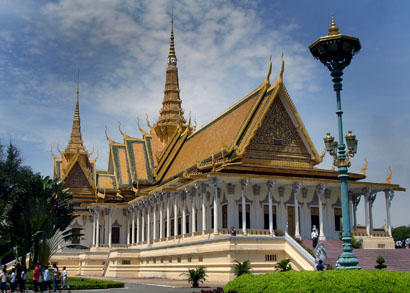
Cambodia's Royal Palace

Image hosted by Photobucket.com

Almost as soon as I had finished feeding the hungry ghost of Pchum Ben, the sun began to rise on my final afternoon in Phnom Phen. I took a quick nap before making an all-too-quick trip to the Russian Market (so named because the Russians used to shop there), before boarding another tuk-tuk to see the Royal Palace.

Image hosted by Photobucket.com

Golden tiles glimmered in the afternoon sun, as the richcolors of the dramatic rooflines anchored themselves firmly in the ocean blue sky like the golden talons of an eagle. As I passed through the gate I was told the palace would close in 30 minutes for the afternoon 'siesta'. Knowing that in 2 hours I would be well on my way to Vietnam, I rushed through the beautifully sculpted gardens overwhelmed by the bold colors, elegant architecture and intriguing skyline of the palace grounds, peirced by strong, A-frame rooftops and spindling spires bent towards heaven like plants towards sunlight.

Image hosted by Photobucket.com

Image hosted by Photobucket.com

Image hosted by Photobucket.com


Image hosted by Photobucket.com

The Royal Palace is the residence of King Sihanouk of Cambodia. It consists of several buildings including the magnificent Throne Hall, where coronations and official ceremomies take place, the Silver Pagoda (so named because the floor is covered with over 5000 silver tiles), an iron house given to King Norodom of Cambodia by Napoleon III of France, libraries, shrines dedicated to the past kings of Cambodia and several royal offices. Many of the precious items once displayed in the Royal Palace and the Silver Pagoda were destroyed by the Khmer Rouge.

Image hosted by Photobucket.com

Image hosted by Photobucket.com

The earliest Buddhist religious monument, built to house relics and remainss and official ceremomies take place, the Silver Pagoda (so named because the floor is covered with over 5000 silver tiles), an iron house given to King Norodom of Cambodia by Napoleon III of France. Many of the precious items once displayed in the Royal Palace and the Silver Pagoda were destroyed by the of the buddha after his death, the stupa evolved into the pagoda as Buddhism spread to other Asian countries. "When a great teacher passes away, his body is no more, but to indicate that his mind is dwelling forever in an unchanging way in the dharmakaya (world of truth), one will erect a stupa as a symbol of the mind of the buddhas" - HH Dilgo Khyentse Rinpoche.

Image hosted by Photobucket.com

Image hosted by Photobucket.com

The Killing Fields


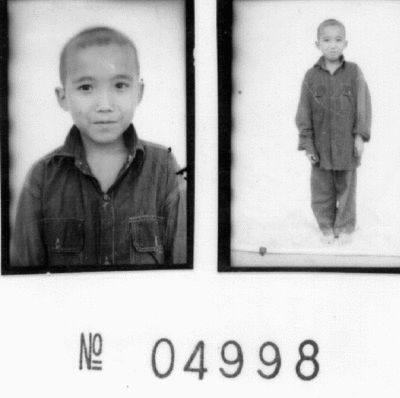
A nameless victim of the Cambodian genocide. Few Americans know that close to two million people died, that none of the perpetrators have been brought to justice and that the United States helped bring about the crisis that lead to the Khmer Rouge takeover.

On April 17, 1975, "The Day of Anger", as it is remembered, thousands of Phnom Penh residents celebrated in the streets as Khmer Rouge troops victoriously entered the capitol. This joyous celebration of the end of the five-year civil war was an expression of hope that Cambodia would finally be at peace.

Hope quickly turned to fear as the Khmer Rouge troops, embittered and toughened by years of brutal civil war and American bombing, marched the boulevards of Phnom Penh ordering people to abandon their homes and evaquate the city. When the residents questioned their orders, the Khmer Rouge claimed they wanted to save as many people as possible from the imminent attack of the Americans, who would soon be bombing the city. Residents would only be gone a few days, they were told, so there was no need to take personal belongings or much food. 2 million people were forced from the city to the countryside, on foot. The wounded were forced out of hospitals to make the trek; some of them were wheeled out on hospital beds. Many died along the way.

There were no American plans to attack the city, as the Khmer Rouge well knew. Cities, they believed, were living, breathing capitalist tools, and Phnom Phen was "the great prostitute of the Mekong." In an ideal communist society, all people would have to live and work in the countryside as peasants, the Khmer Rouge communist ideal. 'Old people', as they called them, were simple, uneducated, hard-working, and almost incapable of exploiting others. Though their way of life had not changed for centuries, they always managed to survive. City dwellers, or 'new people', were the root of all capitalist evil whether they were teachers, tailors, civil servants or monks, and instantly became the new enemies of Angka, "The Organization".

As was often said by the Khmer Rouge, 2000 years of Cambodian history had now come to an end; April 17 was the beginning of Year Zero for the new Cambodia: Democratic Kampuchea. Religion, money and private ownership were all banned; communications with the outside world elimated; family relationships dismantled. The Khmer Rouge regime arrested, tortured and eventually executed anyone suspected of connections with the former or foreign governments, professionals, intellectuals and any Khmer person who broke their rules. Ethnic Vietnamese, Cambodian Christians, Muslims and the Buddhist monkhood were also targets of persecution. If a person knew a foreign language, had worked for the French or Americans, or dared to express feelings of love to their husband or wife, they were killed. Almost 2 million Cambodians would die, 30% of the Cambodian population during that time. Cambodians began to refer to their country as the killing fields, a land of skulls and bones with rivers of blood.


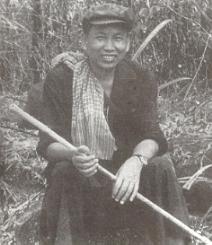
Little was known of the leader of the Khmer Rouge, a Paris-educated communist named Saloth Sar, who went by the nom de guerre “Pol Pot.” Often compared with the regimes of Adolf Hitler,Joseph Stalin, and Mao Zedong, the Khmer Rouge was probably the most lethal regime of the 20th century, in terms of the number of people killed relative to the population. Nevertheless, only three of the Khmer Rouge leaders have been imprisoned since their rule ended, one on unrelated charges.


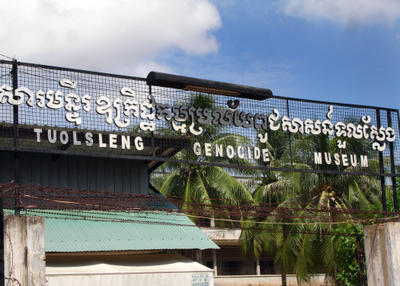
As hundreds of thousands of Cambodians slowly starved in the rice fields, a select number of political prisoners and their families met a terrible fate inside Khmer Rouge interrogation centers. The most infamous of these centers, codenamed S-21, was located in the abandoned suburban Phnom Penh high school of Tuol Sleng, "hill of the poison tree." To workers assigned by the Khmer Rouge to the Tuol Sleng neighborhood, S-21 was known simply askonlaenh choul min dael chenh - "the place where people go in but never come out." Tuol Sleng's reputation was brutally accurate: the sole purpose of S-21 was to extract confessions from political prisoners before they were taken away for execution near the farming village of Choeung Ek. Of the 20,000 people known to have entered Tuol Sleng, only six are known to have survived.


Thousands of confession files, including 5,000 photographs, survive to this day, giving us a grim look at the activities that occured inside Tuol Sleng. The Yale Cambodian Genocide Centerhas spent many years examining these records, but thousands of the people sent to S-21 have yet to be identified. We may never know who they were or why they were sent there; only their portraits remain to serve as affirmations of their lives - and deaths - at the hands of the Khmer Rouge. When I asked why they had bothered to photograph all their victims, leaving proof of their crimes, my guide told me they wanted to prove to Angka that they were doing their job.

Image hosted by Photobucket.com
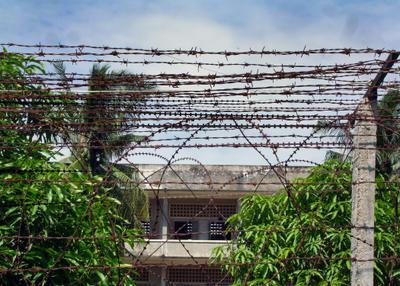
The shadows of barbed wire lining the hallways of Toul Sleng, added after a woman committed suicide by jumping from the second floor to escape her torturous fate. Another victim managed to take hold of a gun left in a torture chamber, shoot his gaurd, and then take his own life.


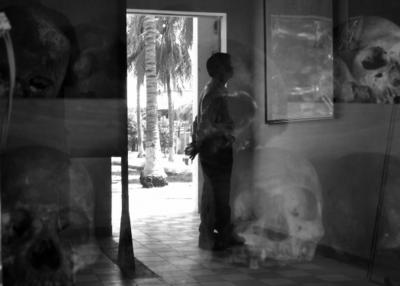
Our guide through Tuol Sleng and Cheong Ek, Mr. Ran, refelcted in a glass case containing the skulls of victims unearthed on school grounds. Hundreds of Cambodians now make a living by guiding visitors through the killing fields, many sharing their harrowing personal stories of how they survived the Khmer Rouge.

The Killing Fields at Choeung Ek. This mass grave, discovered in 1980, was one of the first proofs to the outside world of what had occurred during Pol Pot's regime.

Image hosted by Photobucket.com
Mr. Ran explained that bullets were too precious to use for executions. Pick axes, knives and bamboo sticks were far more common. Even the jagged egde of this common Cambodian plant became a tool for torture and murder.

Image hosted by Photobucket.com
A memorial stupa stands in the center of the killing fields, housing 8,000 skulls from the surrounding mass graves.

Image hosted by Photobucket.com
The Cambodian flag, outlawed by the Khmer Rouge, reflected in the glass shrine of the killing fields.


Image hosted by Photobucket.com
The sight of the skulls stuns visitors into silence. Cambodians will tell you that their genocide is worse than any other because it was carried out on Cambodians, by Cambodians.


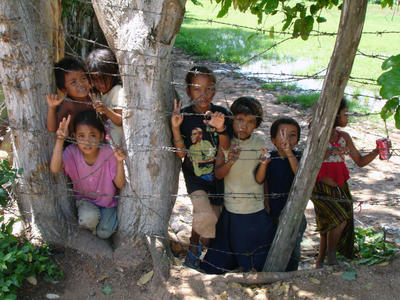
Children from the surrounding farms greet visitors to the killing fields, begging for money.

Image hosted by Photobucket.com
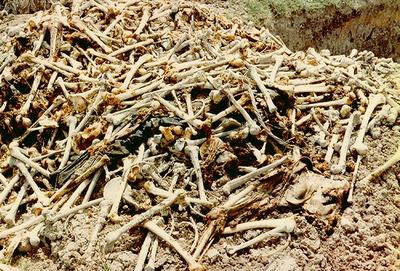
Nine miles from Phnom Penh, the "killing fields" of Choeung Ek are a few of thousands of other such sites around the country where the Khmer Rouge committed genocide during the late 1970s. Water buffalo graze in the surrounding farmland as human bones are unearthed after heavy rains. As i walked through the feilds, I struggled not to step on bones pooking through the dirt paths, discovered by the monsoon rain. Along the path, small barrels were filling with the remains of the thousands of victims massacred here.


Image hosted by Photobucket.com

Image hosted by Photobucket.com

Apsara

Image hosted by Photobucket.com

Apsaras are an embodiment of the ideal female beauty in Cambodian culture. Both modern and ancient Khmer artists rendered them elaborately and with great emotional intensity.


Dance in Cambodia is as ancient as the temples of Angkor, whose carved facades seem to dance. A single gallery in Angkor Wat alone features over 1,500 of these dancing nymphs, synonomous with the Cambodian idea of beauty. The word apsara derives, like much of the culture of ancient Angkor, from Indian Hindu influences. Apsaras were lesser goddesses of unimaginable beauty who danced for the entertainment of higher gods.

Image hosted by Photobucket.com
The dancers originally performed topless, and so they are often depicted in has-relief. It was only due to later Chinese influence that they began performing clothed. The dances features over 4,500 body movements known in Khmer as kbach. A pin peat ensemble consisting of oboes, xylophones, gongs and drums provides musical accompaniment along side singers who narrate the stories.

Image hosted by Photobucket.com
The term "apsara dance" today is interchangeable with court classical dance. At the height of the Khmer Empire, it is estimated that there were 3,000 Apsara dancers in the 12th century court of King Jayavarman VII. When Angkor was sacked in at the begining of the 15th century, the Apsara dancers were seized and taken to Thailand. Classical dance survived, and its influence spread throughout the region.


The Khmer Rouge considered dancing to represent the decadent Royalist society itwas determined to stamp out. Its proponents were executed or sent from their city homes to work in a countryside they did not understand. It is estimated that 90 percent of all dancers and musicians were killed during the reign of the Khmer Rouge regime. Along with them died the knowledge of many dance and theatre forms. Thankfully, those who survived have dedicated themselves to preserving this ancient art of Cambodian culture, and passing it on to the next generation.